micro en série

Thermal decontamination of biological effluents

BSL1, BSL2, BSL3 & BSL4 thermal treatment.

Every organization that handles live microorganisms, viruses, bacteria, spores, or pathogens generates biological effluents that are prohibited from being discharged without prior treatment. Whether you operate a university research laboratory, a biopharmaceutical production unit, or a high-volume industrial site, your effluents must be decontaminated before discharge into sanitary sewers or the environment. It is a regulatory obligation, a biosafety requirement, and an environmental responsibility. Our thermal decontamination systems meet these obligations for all organization sizes, effluent volumes, and biosafety levels from BSL1 to BSL4.

schéma technique
ultimate - décontamination

What is thermal decontamination of biological effluents?

Thermal decontamination is the benchmark process for treating liquid biological waste. Its principle is simple and proven: heat the effluents to a high temperature for a sufficient time to destroy all living microorganisms present—including vegetative bacteria, viruses, yeasts, molds, and even the most heat-resistant forms such as bacterial spores.

The time/temperature combination applied is defined by the required lethality level, expressed as an F0 value. This standardized parameter allows for the validation and comparison of treatment cycle efficiency regardless of operating conditions. For example, a system reaching an F0 of 25 guarantees a reduction in microbial load equivalent to 25 minutes of exposure at 121°C (the standard reference level).

Unlike chemical processes, thermal decontamination does not generate chemical residues in the treated effluents, requires no chemical consumable management, and offers quantitative traceability of the treatment level applied to each cycle. This is why it is the preferred technology in regulated environments, including biopharmaceutical, hospital, and GMP-compliant industrial sectors.

Why is biological effluent decontamination mandatory?

A regulatory obligation in Canada and abroad

In Canada, the handling of biological agents and the discharge of biological effluents are governed by the Public Health Agency of Canada (PHAC), Health Canada, and applicable provincial regulations. Laboratories and industrial sites operating under biosafety levels BSL2, BSL3, and BSL4 are required to treat their biological effluents before any discharge. Non-compliance exposes organizations to regulatory sanctions, suspension of operating permits, and potential civil and criminal liability.

Micro decontamin

A biosafety requirement to protect people and the environment

Untreated biological effluents represent a contamination risk for wastewater network personnel, downstream water treatment operators, and aquatic ecosystems. Pathogenic microorganisms can survive for several hours to several days in liquid waste, depending on their nature and environmental conditions. Thermal decontamination eliminates this risk at the source before the effluents leave the facility.

A prerequisite for audits and certifications

Biopharmaceutical organizations subject to Good Manufacturing Practices (GMP), ISO 17025 accredited laboratories, and certified industrial sites must document and validate their effluent decontamination processes. An automated decontamination system with cycle recording and parameter traceability is a prerequisite for satisfying regulatory auditors and stakeholders.

Two technological approaches: Batch and Continuous

Batch treatment: for discontinuous flows and complex effluents

A batch decontamination system treats a defined volume of effluent in a complete cycle: filling, heating, holding, cooling, and draining. This approach is suitable for organizations where effluents are generated discontinuously—at the end of a production cycle, during cleaning operations, or in variable quantities based on lab activity. It is also the only viable technology for effluents laden with solids, biomass, suspended particles, or high-viscosity products. Cycle-by-cycle validation and batch traceability make it ideal for highly regulated environments.

Continuous treatment: for steady flows and high volumes

A continuous decontamination system treats effluents in a permanent flow, without interruption between cycles. This approach is suited for organizations where effluents are generated steadily and consistently throughout the production day. It offers a high hourly flow rate with no downtime, a compact footprint per litre treated, and more efficient energy recovery through steady-state heat exchange. It is the preferred solution for large laboratories and industrial sites with daily volumes exceeding several thousand litres.

Combining both technologies on a single site

On complex sites, both technologies can coexist: a continuous system for aqueous production effluents generated in a steady flow, and a batch system for cleaning effluents laden with solids or biological residues. Our technical team can help you design a global solution adapted to your site’s specific reality.

How to choose your thermal decontamination system?

The choice of a system rests on five fundamental criteria that must be analyzed before any investment decision:

Cyclobatch - BDS - décontamination industrielle

Daily effluent volume

The daily volume of wastewater to be treated. This is the primary sizing criterion. It determines the size of the system and, for modular systems, the number of units required. Undersizing creates operational bottlenecks; oversizing results in unjustified capital and operating costs. The volume must be assessed taking into account production peaks and medium-term growth prospects.

Nature of the effluents

Clear aqueous effluents are compatible with all our systems. Effluents containing solids, dense biomass, suspended particles, or viscous products absolutely require a batch system with tangential steam injection. The presence of aggressive chemicals, chlorides, or oxidizing agents necessitates a specific selection of construction materials. This analysis is critical to the long-term reliability of the system.

Décontamination directsteam
Stérilisateur en continu

Available site utilities

Almost all of our systems are steam-powered. The FDS is also available in an electric version for sites without steam infrastructure. Some batch systems require chilled water for the cooling phase. These infrastructure requirements must be taken into account during the selection phase.

Regulatory and qualification requirements

Biopharmaceutical sites subject to GMP have specific requirements regarding equipment qualification (IQ/OQ/PQ), component traceability (MTR certificates), and a recognized automation platform. Sites handling Class 3 pathogens have additional containment requirements. These regulatory criteria directly influence the choice of system.

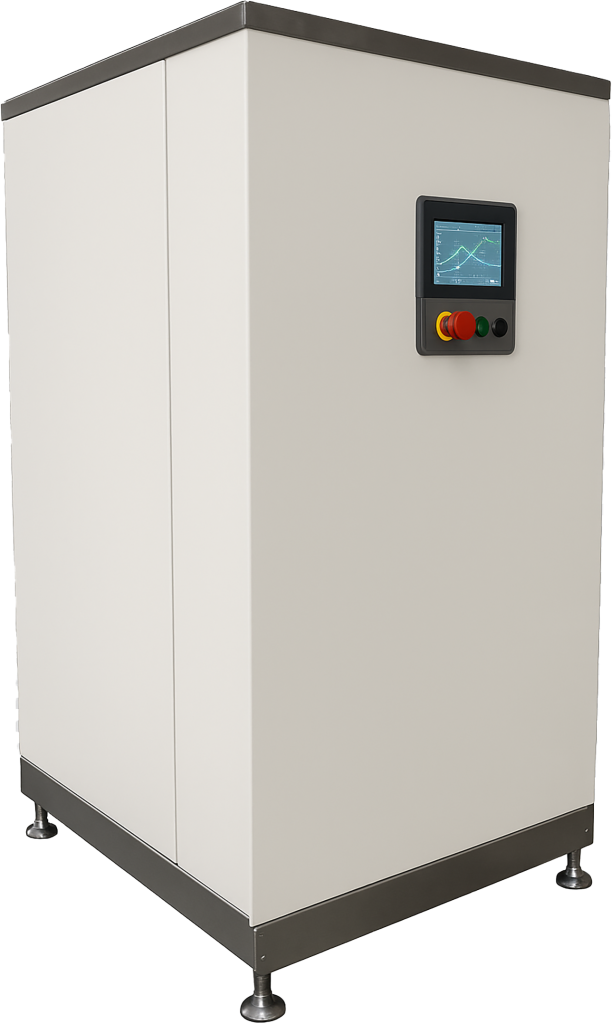
KUBE Actini decontamination system
ultimate plus - décontamination industrielle

Future scalability

For organizations whose wastewater volumes are expected to grow, the modular design of some of our systems allows capacity to be increased in stages, without replacing equipment or requiring additional automation engineering. This is a key financial and operational consideration for growing organizations.

schéma technique

Our support

A personalized study conducted by our engineers.

Selecting a thermal decontamination system is more than just picking from a catalogue, it is a technical, regulatory, and financial decision. Our team of specialized engineers offers a free analysis of your daily volumes, effluent nature, infrastructure constraints, and biosafety levels. Based on this analysis, we will recommend the system best suited to your operational reality.